Every once in a while, just for fun, I run a word frequency count on a Shakespeare play. The results probably don't mean a whole lot but they do give kind of an interesting look at what language is used most in the play.
Here are some of the top words used in Romeo and Juliet and how often they appear (including stage directions):
romeo Count: 294
you Count: 291
thou Count: 276
me Count: 264
not Count: 258
with Count: 251
juliet Count: 176
thy Count: 167
what Count: 164
will Count: 147
nurse Count: 143
thee Count: 139
love Count: 135
capulet Count: 133
shall Count: 110
lady Count: 105
come Count: 97
friar Count: 97
ill Count: 84
mercutio Count: 83
now Count: 82
good Count: 82
benvolio Count: 80
death Count: 69
well Count: 68
night Count: 68
tybalt Count: 67
we Count: 66
man Count: 64
there Count: 64
hath Count: 63
our Count: 60
paris Count: 59
their Count: 47
give Count: 47
yet Count: 47
doth Count: 47
dead Count: 47
let Count: 45
tell Count: 45
fair Count: 43
day Count: 42
take Count: 41
montague Count: 41
first Count: 33
prince Count: 33
sweet Count: 33
gone Count: 33
Sunday, May 15, 2016

A Dream of Romeo and Juliet

We've been attending Seattle Shakespeare Company's more regularly over the past couple years and continually grow more impressed with the accomplishment of their productions. Yesterday's play was Romeo and Juliet and, once again, we are VERY impressed.
One tactic that Seattle Shakespeare has used in several plays now is to do something unexpected that takes audience members off guard and immediately immerses them in the world of the play. For example, last Fall's Comedy of Errors had an aerialist swinging on the pendulum of a giant clock. Romeo and Juliet was framed within scenes of people trapped without their will or understanding on a stage and forced to act out parts they did not choose. There is a hint that everything that happens is a dream or an illusion...including time and its demands. It worked extraordinarily well, changing the audience from intentional viewers of an artistic production on a rainy Saturday afternoon into "observers" of "real people" trying to act on a bewildering and violent world they wake up in and make their story a romance...not a tragedy.
Memes are all the rage on the Internet these days and there is one that scoffs at the notion that Romeo and Juliet is really a love story. The thing to consider is, if circumstances had been different it COULD have been the beginning of an excellent love story. IF Romeo and Juliet were not members of families literally at war with one another. IF duels to the death were not commonplace. IF there had been just a little more time...


The character of Juliet was played by Anastasia Higham. She carried out this first starring role in a production perfectly. A year ago, I saw her playing various roles in the Seattle Shakespeare touring production of Macb....the Scottish play. To see her go in just a year from being little Fleance (anachronistically playing with a toy airplane) to an exquisite young woman experiencing love for the first time in dire circumstances was something special.
But we all know, the love story between Romeo and Juliet isn't taking place in the Forest of Arden. It is taking place in a society rent by strife and violence, strife and violence that are largely personified in the person of Tybalt. Tybalt is the character whose hatred of the Montagues shows itself in a constant desire to fight and kill them. Alan Rickman took a turn as Tybalt in the 1978 BBC production of Romeo and Juliet and his Tybalt was fairly urbane, seeking a fight with Romeo by trying to avoid engaging Mercutio.
Treavor Boykin's Tybalt was something very different and ferocious. This image from the Seattle Shakespeare site of him attacking Andrew Lee Creech's Benvolio captures this incredibly well. These two characters and Trevor Young Marston's pitch perfect Mercutio play a huge part in creating the world of strife in which the play takes place, the violence and the fatalistic acceptance of that violence that it ultimately leads to. Only Benvolio and Romeo among the young men seem interested in finding more to life than carousing and killing.
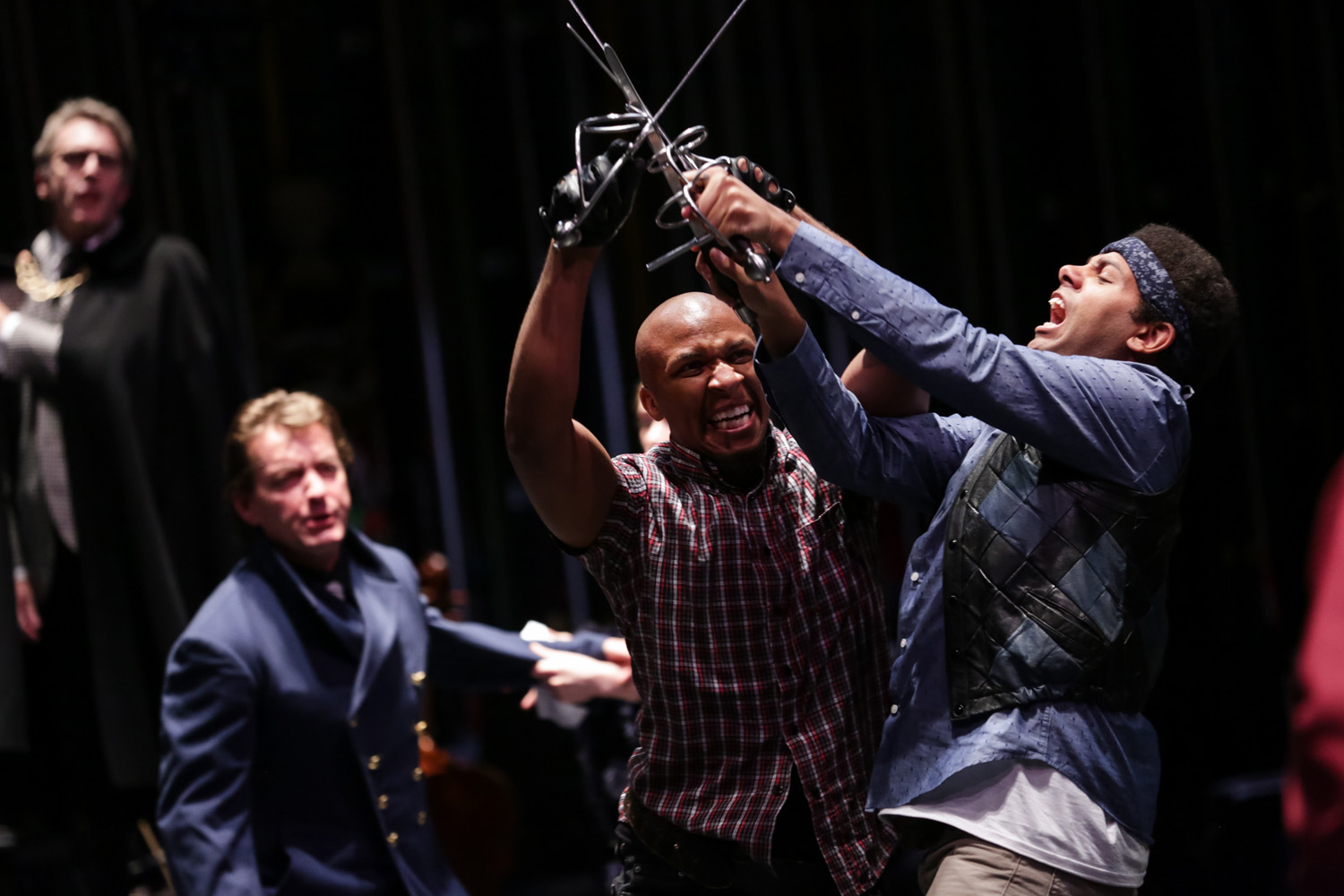
I enjoyed every bit of this performance, both the traditional aspects and the new insights and emphases found by its director, Vanessa Miller. Among the new faces, seeing familiar faces like Mike Dooly (Lord Capulet) and George Mount (playing the Prince, the Chorus and Fate) made the experience familiar, as well as new and thought provoking.
If you haven't seen this production of Romeo and Juliet yet, you have one more week in which to do so. I am volunteering as an usher this week and excited at having an opportunity to see this play one more time!

Actors
Treavor Boykin (Tybalt)
Andrew Lee Creech (Benvolio)
Mike Dooly (Lord Capulet)
Chris Ensweiler (Friar Laurence)
Morgan Grody (Servant)
Anastasia Higham (Juliet)
Justin Huertas (Dream/Death/Apothecary)
Trevor Young Marston (Mercutio)
Claire Marx (Lady Montague)
Carolyn Marie Monroe (Lady Capulet)
George Mount (Prince/Chorus/Fate)
Riley Neldam (Romeo)
Jason Salazar (Ensemble)
Kerry Skalsky (Lord Montague)
Jordan Iosua Taylor (Paris)
Kathryn Van Meter (Nurse)
Elizabeth Wu (Ensemble).
Production Team
Vanessa Miller (Director)
Craig Wollam (Set Designer)
Kelly McDonald (Costume Designer)
Tim Wratten (Lighting Designer)
Robertson Witmer (Sound Designer)
Justin Huertas (Composer)
Crystal Dawn Munkers (Assistant Director/Choreographer)
Geof Alm (Fight Choreographer)
Robin Macartney (Props Designer)
Tori Thompson (Stage Manager)
Wednesday, May 11, 2016
Michael Almereyda's Cymbeline

All of my friends who I've talked to about this movie who are fellow Shakespeare geeks have panned it. I will explain a bit here about why I actually enjoyed this movie and will watch it again...
When evaluating a movie or play, I think a crucial to define the category under which it's being evaluated. For example, evaluating Ian McKellen's Macbeth as a situation comedy would not rate it very highly. There were very few laughs. And evaluating Viggo Mortensen in "A History of Violence" as a musical extravaganza would similarly rate it poorly. This despite the fact that both were excellent, all around.
So how should this version of Cymbeline be rated? As a straightforward Shakespearean production, it would not score very highly. As a Shakespeare geek, applying that measurement was my first thought. Under that categorization, for example, Joss Whedon's "Much Ado About Nothing" was superb. Not that I'm biased, being a total Joss fan boy... :)
But while I was watching this version of Cymbeline, I found myself enjoying it. I wasn't *loving* it but I enjoyed the experience and I know I'll watch it again. Then it occurred to me that I enjoyed it because it did what so few Hollywood movies do these days: it took some big chances and tried to do something memorable. It hired some very talented people (Ed Harris, Milla Jovovich, Anton Yelchin; NOT Ethan Hawke. I'm reserving judgement on the lovely Dakota Johnson) and took on the huge challenge of setting one of Shakespeare's most complex plot lines in a modern setting. Cymbeline is a very thoughtful fairy tale play and thoughtful isn't something we see a lot of in Hollywood. It tried to do something big and succeeded modestly, in my opinion.
So given that categorization, I would recommend taking a look at this movie.
Saturday, April 23, 2016
The Art of April 23
For lovers of literature and culture, April will always have a special significance. By tradition, that is the day on which William Shakespeare was born in 1564 (we know he was baptized 3 days later) and also the day on which he died in 1616.
The 400th anniversary of these milestones were bound to be celebrated with vigor and enthusiasm and such, indeed, was the case. Special events in England reached a crescendo, with special shows and broadcasts highlighting the notable performances of eminent actors. In the US, the Folger Library has sent several of the posthumously published 1623 First Folio to all 50 states, the District of Columbia and Puerto Rico. Bard fever is in the air and millions have joined a worldwide cultural celebration.
But there have been many quiet personal celebrations as well. Here are notes about a couple such celebrations.
On April 23, 1964, this envelope was used to send a letter home to Denmark (thought not to Elsinore Castle) from a visitor to Stratford-upon-Avon. The envelope and stamps were designed by the British Post, highlighting some iconic scenes and characters from Shakespeare's stories. But I find it intriguing to wonder who the visitor was that paused in his trip to Shakespeare's home to send this letter home to a family member or a friend.

52 years later to the day, exactly 400 years after Shakespeare died, this happened. The tattoo was inspired by the Hamlet statue at the Gower Memorial in Stratford-upon-Avon. This is not my Shakespeare tattoo. This is the BEGINNING of my Shakespeare tattoo...


Sunday, April 3, 2016
Shakespeare's First Folio Visits Seattle

Tradition has it that William Shakespeare was born in Stratford-upon-Avon, England on April 23. 1564. During the course of his life, he wrote nearly 40 plays and co-wrote some number of others. He died on April 23, 1616. Yet for a man who lived 400 years ago, his impact on the world has been astonishing. He contributed dozens of common expressions to contemporary speech (e.g., jealousy as the "green eyed monster") and created a number of the most memorable characters in the Western Canon. Some even credit him with creating a model of human consciousness by examining the rich inner lives of his characters.
Yet there were times when these rich cultural treasures could have been lost forever. At the time of his death, only about half his plays had been collected together. Two of his contemporaries, John Heminges and Henry Condell, succeeded in getting the First Folio of Shakespeare's work published in 1623, restoring some nearly lost classics such as Macbeth and As You Like It. Later, legislation enacted by the Puritans crippled theatrical performance from 1642-1660. The Great London Fire of 1666 destroyed nearly half of all editions of the Third Folio.
Our extreme good fortune in having the work of Shakespeare available to us is why the world is celebrating the 400th anniversary of his passing, this year. One of the exceptional things happening this year is that the Folger Shakespeare Library, in cooperation with the Cincinnati Museum Center and the American Library Association, is sending some of the 82 First Folios in its collection out on a nationwide tour. This tour includes all 50 states in the United States, the District of Columbia and Puerto Rico.
Seattle's turn started on March 21 and runs through April 17. Today was our day to visit the First Folio, at the Seattle Public Library..


The terrific thing about this exhibit is that, while it celebrates the First Folio, it was really about a lot more than that one (AMAZING) nearly 400 year old book. OK, I'll look at the First Folio first but there are more cool things to come.

These are the best pictures I got of the First Folio. Obviously, we didn't get to physically touch it but it was open to one of the most well known passages in world literature, Hamlet's "To be or not to be" speech. Even being that close to it physically was like communing with the world of Elizabethan England in some inexplicable way. This IS one of the most famous and important books in the world.


However, Seattle was exceptionally fortunate in that we also had a copy of the Third Folio from the Pigott Collection on exhibit. Moreover, while the First Folio drew a crowd that had a constant stream of people walking in a queue past it, the Third Folio was not looked at quite so much...I got to linger there a bit. The Third Folio was open to As You Like it, specifically Jacques' "All the world's a stage" speech.

Seeing the Third Folio also was quite an unexpected bonus. It is nearly as rare as the First Folio, in that nearly half its printed run was destroyed in the Great Fire of 1666.

We didn't get to physically touch the Third Folio, either, strangely. But the Seattle Library clearly anticipated this frustration by having a number of Folio copies that you could actually flip through. They were quite gorgeous...I think I'll have to add one to my Shakespeare shelves, some day.


There was also an exhibit which highlighted the rich tradition of Shakespeare play performances in Seattle. I've been a fan of the current Seattle Shakespeare company for years, now. It was fascinating to find out how far the area's tradition of performance goes back.


The library has also been hosting a series of performances and lectures to accompany this exhibit.

And there were mementos and kid activities accompanying the exhibit, too.


I really have to congratulate the Seattle Library and its people for doing such a phenomenal job with this exhibit. The exhibit itself was BRILLIANT and the people tracking tickets at its entrance were very friendly, helpful and enthusiastic.
The First Folio's visit to Seattle ends two weeks from today and online tickets were going fast. If you have the time, I seriously recommend try to go...some drop-in admission openings ARE available. Information here.
Sunday, March 20, 2016
As You LOVE It!


Today, I was fortunate enough to see one of the best Shakespeare play productions that I've seen. It was a close thing because there was over an an hour's drive involved, not to mention other complications. But it was SO worth it!
We arrived at the Pickford Film Center in Bellingham with some trepidation, as there were some traffic signals unpowered for a few blocks. Sure enough, when we got to the theater, all the lights were out and a couple dozen polite Shakespeare fans were talking with the film center operators, who were obviously stressed about getting the film started before it shredded the day's schedule. Fortunately, the power came on and we were able to see this crackling version of As You Like It.
Honestly, I wasn't sure what to expect. The stage design was brilliant here, as it was when the National Theater had Benedict Cumberbatch play Hamlet. But that play was a little disappointing because while Cumberbatch is excellent, I felt like a couple crucial roles were weakly cast (Horatio and Polonius).
However, this play showed that that casting may have been a fluke. The casting for this production was actually astounding. Every SINGLE actor in this play brought excellence to their role and seemed passionate about acting heir heart out. Every actor.
For example, Leon Annor played the role of Charles the Wrestler. It is a role where the character only appears in a couple of scenes but it was still a standout performance.
As for the major roles: WOW! The role of Orlando is regarded as a bit of a numpty much of the time but Joe Bannister invested the role with a humanity, an enthusiasm tempered by a less than pleasant upbringing, that frankly surprised me. He did an excellent job,
Rosalind and Celia's actors, Rosalie Craig and Patsy Ferran respectively, were exquisite. Two multi-faceted, devoted friends, very bright, open to love and utterly gorgeous. Frankly, I find myself utterly smitten with both these performers. Paul Chahidi's Jacques and Mark Benton's Touchstone were also excellent. There is not a single performer here who I would not seek to congratulate. Hell, the actors playing the sheep invested their performances with a surprising humor.
Enough gushing...what does this performance have going for it? Well, the play itself is a favorite because it is a comedy, a fun romp that touches on serious themes but never leaves you worried that something seriously bad is going to befall someone. There is affection and nurturing aplenty...gender roles become very fluid because not only does Rosalind pretend to be a man through much of the play but male roles also involve a nurturing quality. And Shakespeare's right insights shine through: Jacques' 7 ages of men speech and Rosalind's epilogue are classics! (see below)
If you have a chance to see this performance or own the DVD eventually, SEE IT. You'll love it.
Jacques speech:
All the world's a stage,
And all the men and women merely players:
They have their exits and their entrances;
And one man in his time plays many parts,
His acts being seven ages. At first the infant,
Mewling and puking in the nurse's arms.
And then the whining school-boy, with his satchel
And shining morning face, creeping like snail
Unwillingly to school. And then the lover,
Sighing like furnace, with a woeful ballad
Made to his mistress' eyebrow. Then a soldier,
Full of strange oaths and bearded like the pard,
Jealous in honour, sudden and quick in quarrel,
Seeking the bubble reputation
Even in the cannon's mouth. And then the justice,
In fair round belly with good capon lined,
With eyes severe and beard of formal cut,
Full of wise saws and modern instances;
And so he plays his part. The sixth age shifts
Into the lean and slipper'd pantaloon,
With spectacles on nose and pouch on side,
His youthful hose, well saved, a world too wide
For his shrunk shank; and his big manly voice,
Turning again toward childish treble, pipes
And whistles in his sound. Last scene of all,
That ends this strange eventful history,
Is second childishness and mere oblivion,
Sans teeth, sans eyes, sans taste, sans everything.
Rosalind's epilogue:
It is not the fashion to see the lady the epilogue;
but it is no more unhandsome than to see the lord
the prologue. If it be true that good wine needs
no bush, 'tis true that a good play needs no
epilogue; yet to good wine they do use good bushes,
and good plays prove the better by the help of good
epilogues. What a case am I in then, that am
neither a good epilogue nor cannot insinuate with
you in the behalf of a good play! I am not
furnished like a beggar, therefore to beg will not
become me: my way is to conjure you; and I'll begin
with the women. I charge you, O women, for the love
you bear to men, to like as much of this play as
please you: and I charge you, O men, for the love
you bear to women--as I perceive by your simpering,
none of you hates them--that between you and the
women the play may please. If I were a woman I
would kiss as many of you as had beards that pleased
me, complexions that liked me and breaths that I
defied not: and, I am sure, as many as have good
beards or good faces or sweet breaths will, for my
kind offer, when I make curtsy, bid me farewell.
Wednesday, February 24, 2016
The Next Whedon Shakespeare
A couple days ago, there were some posts on Twitter, asking which Shakespeare play Joss Whedon should do next. To die-hard fans of Joss and the talented actors with whom he works, the possibilities for awesomeness are practically endless. Joss did a brilliant job with a Much Ado About Nothing. You could argue that Buffy that Vampire Slayer is the story of the seemingly under-prepared Prince Hal from Henry IV Part 1. That probably means that The First is Hotspur...
Limiting ourselves to the more well known plays, a few interesting possibilities that I would love to see would be:
Heh. Adam Baldwin as Hamlet...
However, there is another play that's less well known, which I think would be a natural for Joss to take on next: Troilus and Cressida. This play is set during the Greek siege of Troy and tells the story of various pairs of lovers acting their parts on that stage: Troilus with Cressida, Diomedes with Cressida, Paris with Helen of Troy, Achilles and Patroclus.
This play is a gold mine of the material that Joss works with best. It is easily Shakespeare's snarkiest play, opening with a prologue that veers crazily from serious to sarcastic, repeatedly. It ends with the cheeky suggestion that viewers are free like the play or not...the playwright doesn't care.
The plot lines in Troilus and Cressida are both comic and tragic, genre-bending material at its finest and therefore natural Whedon fare. There is doomed love, there are doomed heroes, there are comic breaks during moments of tension. There is an epic eavesdropping scene, battles and pointless death. Done up by Joss, this would be FANTASTIC!
And half the fun would be casting it. I don't have it all worked out but these are some casting options that would be pretty excellent:

Limiting ourselves to the more well known plays, a few interesting possibilities that I would love to see would be:
- Clark Gregg as King Lear
- Alan Tudyk and Gina Torres reunited as the Macbeths
- Adam Baldwin as Hamlet
Heh. Adam Baldwin as Hamlet...
However, there is another play that's less well known, which I think would be a natural for Joss to take on next: Troilus and Cressida. This play is set during the Greek siege of Troy and tells the story of various pairs of lovers acting their parts on that stage: Troilus with Cressida, Diomedes with Cressida, Paris with Helen of Troy, Achilles and Patroclus.
This play is a gold mine of the material that Joss works with best. It is easily Shakespeare's snarkiest play, opening with a prologue that veers crazily from serious to sarcastic, repeatedly. It ends with the cheeky suggestion that viewers are free like the play or not...the playwright doesn't care.
The plot lines in Troilus and Cressida are both comic and tragic, genre-bending material at its finest and therefore natural Whedon fare. There is doomed love, there are doomed heroes, there are comic breaks during moments of tension. There is an epic eavesdropping scene, battles and pointless death. Done up by Joss, this would be FANTASTIC!
And half the fun would be casting it. I don't have it all worked out but these are some casting options that would be pretty excellent:
- Amy Acker, a lovely woman who seems to excel in all kinds of roles, funny and tragic, would be an epic Cressida.
- Clark Gregg would be a fantastic Hector
- Patton Oswalt would be great as Pandarus. Or maybe Thersites.
- My ideal cast might have Tricia Helfer be Helen of Troy. Hey, I can dream...
- How about Nathan Fillion as Ajax?
Subscribe to:
Posts (Atom)

